Projects
Emergency Evacuation Chair Training
Audience: Library staff and managers
Format: Instructor-led safety training · Live equipment demonstration
Tools: Canva, Google Slides, Slido
A safety-focused training experience developed to prepare library employees for the appropriate use of emergency evacuation chairs. The training combines foundational safety information, visual procedural guidance, and a live equipment demonstration, emphasizing both safe operation and respectful assistance for individuals with mobility limitations.
My role
I collaborated with the Manager of Public Safety at St. Louis Public Library to develop instructional materials supporting the organization's evacuation chair training. Working with a subject matter expert, I translated equipment procedures, safety considerations, and operational guidance into accessible training content for employees with varying levels of familiarity with emergency evacuation equipment.
I developed the presentation and incorporated visual step-by-step instructions, equipment illustrations, and interactive discussion prompts to reinforce key safety concepts. I also co-facilitated the accompanying live demonstration with a Public Safety representative, connecting classroom instruction with practical equipment use.
Deliverables
Instructor-led safety training presentation
Visual, step-by-step procedural instruction
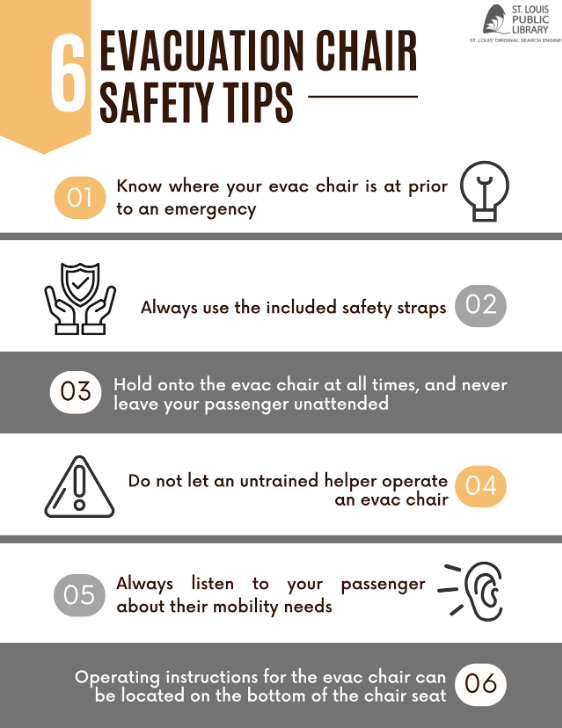
Emergency evacuation chair job aid
Interactive Slido questions and reflection prompts
Co-facilitation of a live equipment demonstration
Design Approach and Challenge
The primary challenge was making specialized emergency equipment procedures understandable to employees who might have little or no experience using evacuation chairs, while ensuring the training remained grounded in established safety guidance.
Rather than relying entirely on technical instructions, I structured the learning experience around three foundational questions: What is an evacuation chair, why is it necessary, and how is it used safely?
I incorporated visual demonstrations of equipment features and operating procedures, interactive knowledge and reflection prompts, and a live demonstration to help participants connect instructional content with real-world emergency situations.
An additional priority was emphasizing the human side of emergency response. The training addressed both visible and non-visible mobility limitations and reinforced the importance of communicating with, listening to, and respecting the needs of the person receiving assistance.
Selected Artifacts
The presentation and job aid show how the instructional materials supported the demonstration.